

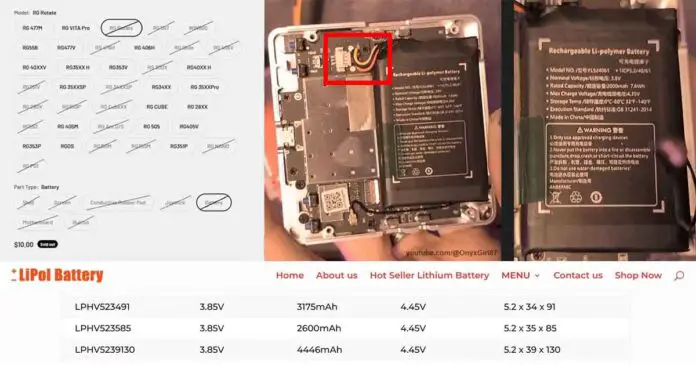
While waiting for my review unit of the Anbernic RG Rotate, my battery anxiety has already kicked in. So naturally, I started to look around for potential replacements for the stock battery that comes with the handheld to soothe my nerves. And the situation looks like this.
You might also like: Miyoo Mini/Plus Battery Replacement Guide – All Models
First, the Official Replacement
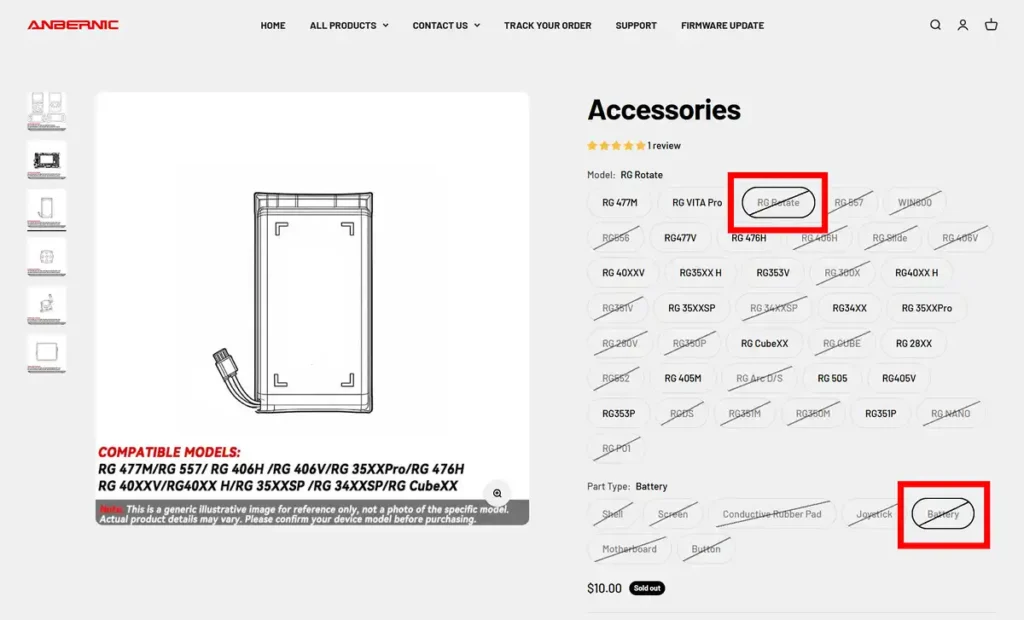
Anbernic does offer an official RG Rotate battery replacement, and you can get the original battery pack directly from their website. However, at the time of writing this article, the RG Rotate battery pack, along with several other Anbernic replacement batteries, was marked sold out, without any info on when they would come back.
Even if the RG Rotate battery pack reappears in the Anbernic store, there is always the question of device longevity. Many consumer lithium-ion cells like these are usually rated for 300–500 full charge cycles until noticeable degradation, and this will also depend on the quality of the used cells.
For an average user, this might be about 2 years of using the device. For a power user doing at least one full battery cycle every day, it’s much less. Regardless of that, it’s important to have options even when the official accessory/part support drops out, which with these kinds of experimental handhelds can happen quite fast.
If I were crazy enough to keep using the Rotate a few years from now, how hard would it be to find a replacement cell for it? This is the exact question that I need answers to, and thus:
The Battery Label Inside the RG Rotate
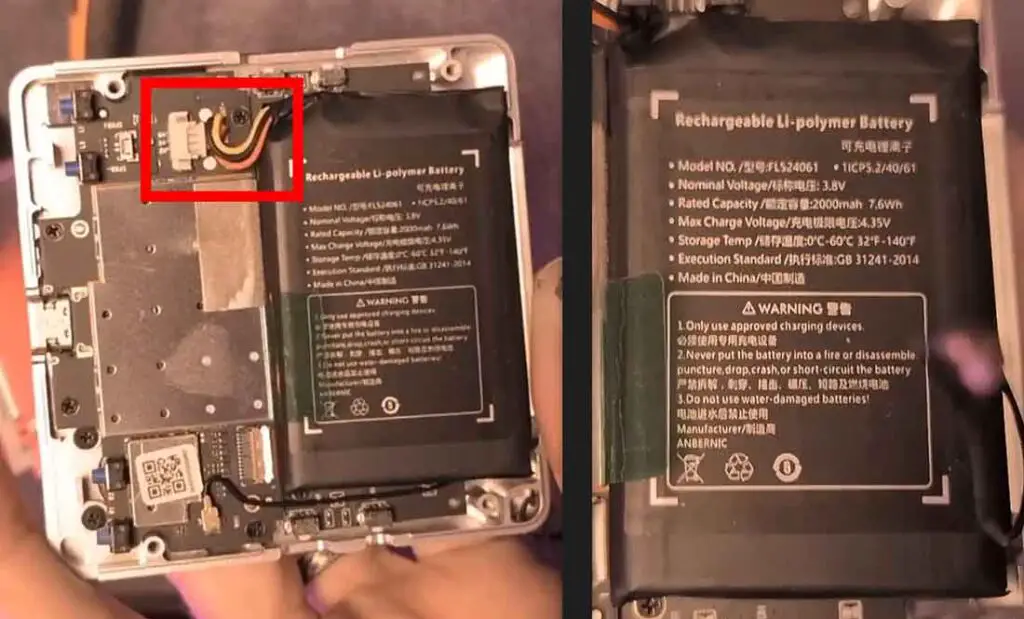
The clearest look at the stock pack I found comes from Onyx Girl’s RG Rotate video. The battery label is readable enough to pull the data we need.
From this internal view we can infer two things. First, the RG Rotate makes use of what looks like a 3-pin JST-GH battery connector. This connector can also be seen very clearly on the disassembly/D-pad fix video by Michi NekoMichi.
Second, the original battery model number appears to be FL524061. It’s a lithium-polymer cell of the 1ICP5.2/40/61 type/size, rated at 3.8V, 2000mAh (7.6Wh), and 4.35V max charge. This is pretty much all the useful info that we can get from the label.
1ICP5.2/40/61 is an IEC-style prismatic-cell designation that can be expanded as follows: Single-cell (1), Lithium-ion (I), Cobalt chemistry (C), Prismatic shape (P), with dimensions of 5.2 x 40 x 61 millimeters.
A quick terminology note: “lithium-polymer” or “LiPo” cells are still part of the wider lithium-ion family. In everyday handheld/electronics use, LiPo usually refers to a flat pouch-style lithium-ion cell, not a totally separate battery type.
This is also not a regular 3.7V cell with a 4.20V charge ceiling. The 3.8V nominal voltage and 4.35V max charge puts it in the high-voltage LiPo group, in short, LiHV.
This makes it harder to simply buy a ready-made pack from Amazon or AliExpress like you can do with the R36S, or the Miyoo Mini. These kinds of cells are typically not readily available for purchase in those outlets. This is where I’m starting to think about other possible sources.
The Third-Party Cell That Lines Up
Quick note before we move on. I have not purchased any items from these kinds of outlets as of now, and all of the information here is based solely on my own online research.
I’ve found a few outlets that sell the less popular cells and battery packs, and are also advertising their ability to prepare custom cell orders.
The outlets I found are mostly Chinese companies that have online catalogs of hundreds of different cell types. Quite curiously during my research I found quite a few similar-looking websites with close to the same inventory, but hosted on different domains. Still, these seem to be legitimate businesses, as far as my untrained eye can tell.
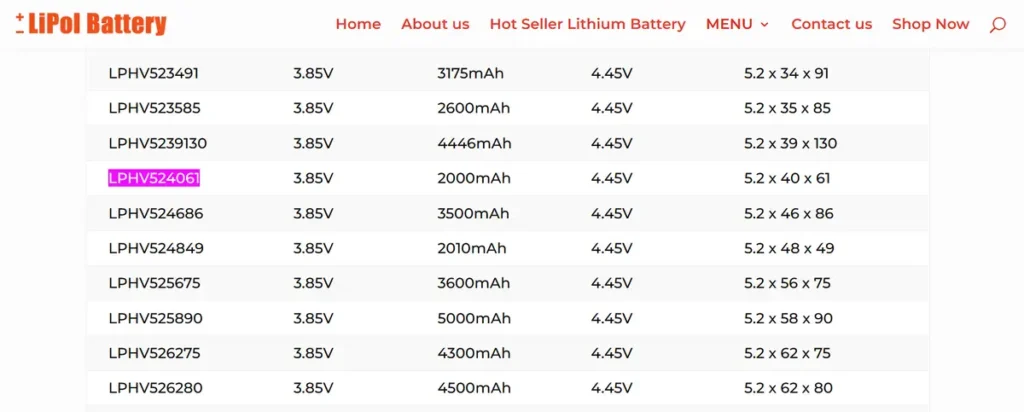
Returning to the possible RG Rotate replacement battery, the LPHV524061 cell from the LiPol Battery catalog is the closest match when it comes to the size and capacity.
The 3.85V high-voltage lithium polymer battery table over on the LiPol website did include this entry:
- Model: LPHV524061
- Nominal voltage: 3.85V
- Capacity: 2000mAh
- Max charge voltage: 4.45V
- Dimensions: 5.2 x 40 x 61mm
That is the closest match I could find online for the actual RG Rotate’s stock pack. The size and capacity line up perfectly. The voltage family is right too. It’s a LiHV cell, not a regular 4.20V LiPo, which is almost exactly what we want.
The only real difference here is the top charge rating. The RG Rotate stock pack label states that its max charge voltage is 4.35V. The LPHV524061 entry from LiPol is advertised as 4.45V.
Assuming the RG Rotate terminates charging at the stock pack’s 4.35V limit, a 4.45V-rated cell could be charged below its printed maximum, likely with some capacity left unused.
So, the LPHV524061 seems to be the best known cell candidate. It is, however, still not a 1:1 drop-in RG Rotate battery replacement. The thing is, the finished pack still needs the correct protection board, NTC value, cable, connector, polarity, and pinout.
An important thing to keep in mind here is that most of these companies won’t let you order just one cell. The most common minimum order quantities were, in the places I checked, anywhere from 3-5 units sold as samples. With custom orders, the rules might differ on a case-by-case basis.
Third Wire, Connector, and Pinout
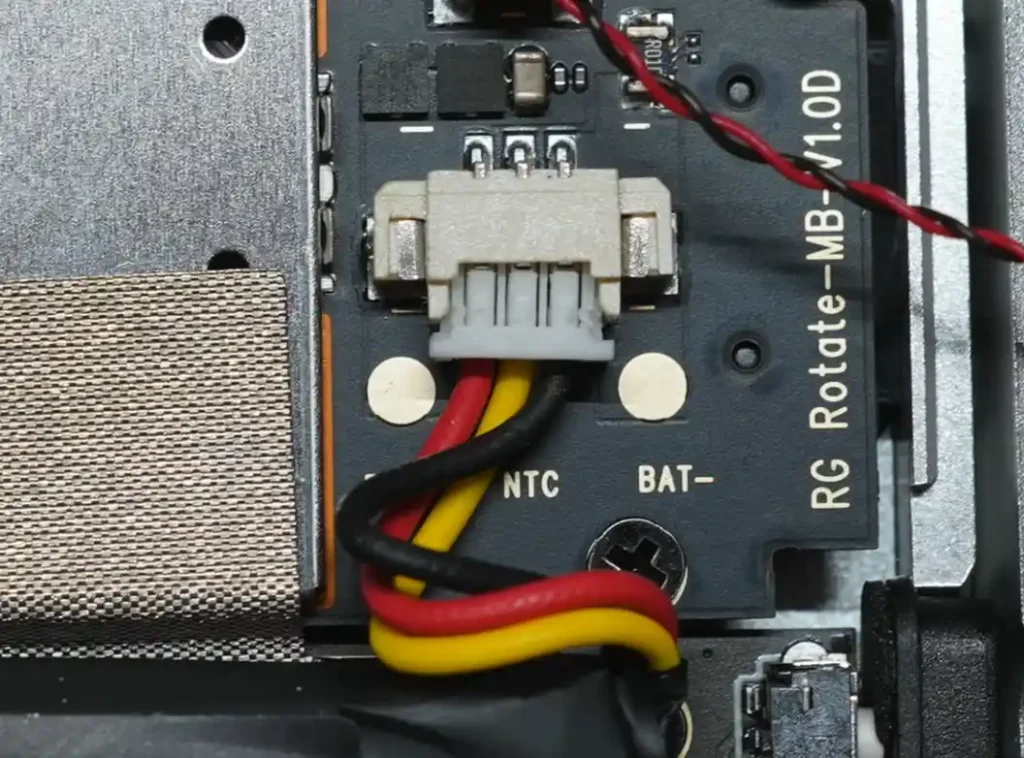
The RG Rotate battery has three visible wires. Red is positive. Black is negative. Yellow is the temperature-sense line, common in this style of packs.
That yellow wire normally runs to an NTC thermistor. The thermistor is a tiny temperature sensor, usually taped to the pouch cell or placed near the protection board under the wrap.
I have not found a public RG Rotate source confirming the exact thermistor value yet. 10 kΩ NTC is a reasonable and commonly used default, as smaller lithium packs often make use of these. Still, it should not be assumed without measuring.
A wrong thermistor value can theoretically let the handheld power on, but charging can fail. The board can read the battery as too hot, too cold, or just missing the required sensor.
The only real way to confirm the value is to unplug the original battery, measure resistance from yellow to black, then from yellow to red. One pair should show a reading. Warm the sensor area with your fingers. For an NTC, the resistance should then start to drop.
A reading near 10K ohms at room temperature points to a 10K NTC. A 47 kΩ or 100K kΩ reading means a different sensor. Once my RG Rotate arrives, I plan to measure the thermistor value myself, although the chance that it’s anything other than 10 kΩ is probably reasonably low.
So, What Do We Actually Know?
The RG Rotate appears to use a 5.2 x 40 x 61mm high-voltage LiPo pack rated at 3.8V, 2000mAh, with a 4.35V charge limit and a 3-wire NTC setup. The closest third-party cell I found is the LPHV524061, but unfortunately it is still only a bare-cell candidate, not a ready-made replacement. Until the connector, pinout, protection board, and thermistor value are confirmed, the official Anbernic battery remains the safest option.
I’m hoping to update this article in the near future, as we gather more data and the support for the device matures. That’s pretty much it for now!
You might also like: R36S Handheld Battery Replacement & Common Issues