


Ever found a drawer full of loose batteries and wondered which ones are still good? I sure did, just a few days back. Instead of guessing or, even worse, throwing away perfectly good cells, a small handheld pocket battery tester can save you money and frustration, and it’s a quick, inexpensive buy that can last you for years. And they can test all kinds of batteries, from AA and AAA types to button cells and large 9V batteries, lithium, and alkaline.
In this short guide, I’ll show you the best and most affordable pocket battery testers you can get, with hands-on recommendations. We’ll look at simple analog models and digital ones that provide precise voltage readings, with both open and closed-circuit options available. So, let’s get to it.
You might also like: KWS-2302C USB-C Charger Power Tester Dongle Review
Why you can trust us: We test all of our products according to the TechTactician consumer usability benchmark methodology which evaluates all of the product characteristics that matter to the user in day to day use. Enjoy the review!
This web portal is reader-supported, and is a part of the AliExpress Partner Program, Amazon Services LLC Associates Program and the eBay Partner Network. When you buy using links on our site, we may earn an affiliate commission.

Power Source: Test Battery
Circuit Type: Closed-Circuit

Power Source: Test Battery
Circuit Type: Closed-Circuit

Power Source: Test Battery
Circuit Type: Closed-Circuit

Power Source: Test Battery
Circuit Type: Closed-Circuit

Power Source: Int. Battery
Circuit Type: Open-Circuit

Power Source: 1x AAA Battery
Circuit Type: Open-Circuit
Why Bother With a Battery Tester?

The main reason is simple: to avoid throwing away perfectly good batteries. Many devices, especially high-drain electronics, will stop working when a battery’s voltage drops slightly, sometimes even if it still has about 50-60% of its charge left.
These “weak” batteries are often perfect for low-drain devices like TV remotes, clocks, or wireless mice and can be used for many more days once they are removed from your high-power-drain devices. A tester can instantly tell you which batteries to keep for these kinds of tasks.

It also works the other way around, helping you quickly identify and discard completely drained cells, which can often leak and damage your electronics if left inside them for too long, especially when it comes to alkaline cells. For a few dollars, a good tester is a tool that pays for itself.
With all that said, let’s get straight to the list starting with the device I had the pleasure to test first.
Self-Powered (Closed-Circuit)
1. BT-168 PRO Battery Tester (Digital)
- Gives you a precise digital voltage readout.
- No internal battery required; powered by the cell being tested.
- Sliding contact requires a rather firm grip to hold the battery securely.
This is arguably the most common and reliable pocket battery tester design available. The digital version of the BT-168 PRO battery tester is small, works with all of the most common battery types, has a neat cell voltage display with large digits, and, just like all of the other self-powered devices on this list (the first four), is powered solely by the battery you’re testing.
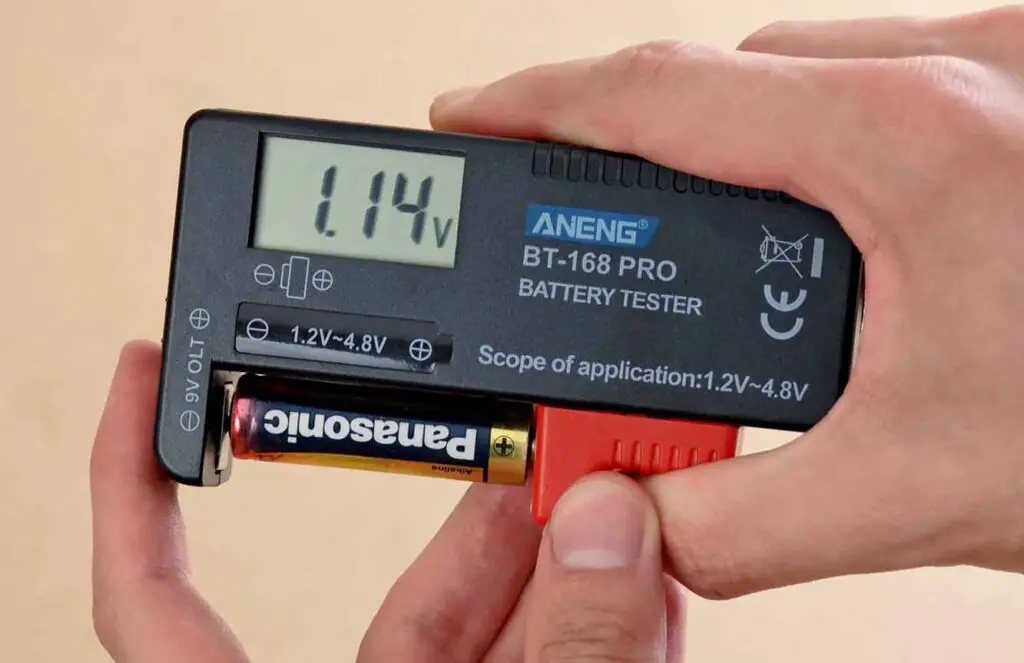
The design with the sliding rail used to adjust the spacing between the positive and negative contacts of the tested battery is really convenient. Just be sure not to drop your cells if you’re not holding the slider firmly enough (it happened to me a few times). The exact voltage readout on the screen, sheer convenience of use, and its extremely low price is why I decided to place it in the first position of our list. Oh, and it also has a small cheat sheet on its back, should you ever forget what voltage levels are acceptable for both 1.5V and 9V battery types.
2. BT-168 Battery Tester (Analog)
- Simple, easy-to-read analog dial for a quick check.
- Doesn’t need its own battery to operate.
- Lacks the precision of a digital display; only shows general levels.
The BT-168 is essentially a direct analog equivalent of the BT-168 PRO. While the PRO version features a display which will show you the exact voltage of your tested cell, the BT-168 has an analog dial in place, with a simple gauge with “replace”, “low”, and “good” indicators, and a separate gauge for button cells.
While this isn’t as accurate a reading as the digital “PRO” model above would give you, some people do prefer to quickly eye the test result, rather than go by numbers with each new tested battery. If you prefer to go analog, this is a great option to consider.
3. Universal All-in-One Battery Tester (Digital/Analog)
- Dedicated slots for each common battery type.
- Clear bar graph display is easy to interpret at a glance.
- Can be awkward to position and secure batteries in the contacts.
This C-shaped universal battery tester design, sold under many different brands, is quite interesting. It’s an all-in-one solution with separate slots for each battery type, including contacts for the larger 9V batteries, and button cells. It also features a digital display with two separate voltage scales for 1.5V and 9V batteries printed on its sides.

While I really liked the idea of combining the “analog” representation of the battery charge level using the bars going up on the display with the printed-on discrete voltage values, you will have to practice positioning the cells in the right way for them to connect at first. While the negative contacts only have to touch a small part of the bottom metal plate, squeezing the batteries in between the two contacts can be a little bit awkward as you can see on the image above.
4. BT-189 Battery Tester (Digital)
- Shows the exact battery voltage on its digital display.
- The same all-in-one design with multiple battery slots.
- Once again, the battery placement can be tricky due to the fixed contact design.
The BT-189 battery tester is built in almost exactly the same way as the previous device that we’ve tested, but this time it features a digital display with the exact voltage values shown in large digits, much like the BT-168 PRO.
While positioning the batteries in the correct way can be tricky in the beginning because of its “crescent moon” design, it’s a great pick for those of you who prefer to have access to easily visible direct voltage readouts for each cell that you’re testing.
Now let’s move on from the battery-less, closed-circuit testers, to open-circuit ones that don’t drain the energy of the tested battery, but in turn, require power to function.
Battery Required (Open-Circuit)
5. Dlypow Battery Tester (Digital)
- Doesn’t drain the battery being tested.
- Includes an auto-off feature.
- Relies on its own in-built battery to function.
The Dlypow battery tester, unlike the other devices you can see on this list, requires power other than the power of the tested cells to operate (and won’t require a recharge for a few months). It has its own internal battery, and comes with a small charging cable. Other than that, it’s reasonably small, can be easily turned on and off using the “Select” button, and will automatically turn off after it’s been idle for 30 seconds.
It features a digital voltage display, an additional “poor”, “weak”, “good” status indicator, and most importantly, lets you choose the voltage range for the cell you’re testing. Being really lightweight, compact, and having an additional magnetic element to let the tested battery safely snap into place, it’s another great option to consider.
6. KKEANIC Battery Tester Set (Digital)
- Includes a storage case to organize up to 32 batteries.
- Easy-to-read display shows both voltage and a capacity bar.
- Requires a separate AAA battery to operate.
Last on our list is the KKEANIC battery tester set. This one also requires one AAA battery to operate, but it’s also paired with a simple plastic case which can fit the device itself, alongside 32 batteries (12 AAAs and 20 AAs). This is a pretty good way to store your spare cells and sort them by their remaining charge.
Aside from the easy-to-read digital display, it also shows you the capacity of each tested battery in the form of a bar going from “poor”, through “weak”, to “good”. It’s a really nice solution if you want to be able to quickly tell the results of the test just by glancing at it, but you also want the ability to tell the exact amount of power your cells have left in them. Overall, it’s a really good solution if you don’t mind it needing extra power to work.