
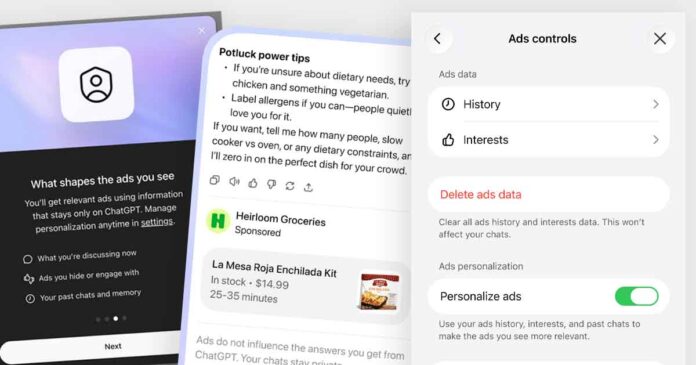
OpenAI is now testing ads inside ChatGPT in the US, showing clearly labeled “Sponsored” placements beneath some responses for users on Free and Go. OpenAI asserts that ads do not influence the model’s answers and the company promises that advertisers won’t be able to look into your chat data.
You might also be interested in: OpenAI GPT-5.3 Rollout: 4o & 4.1 Going Away For Good?
What Exactly Is Happening (And Where)
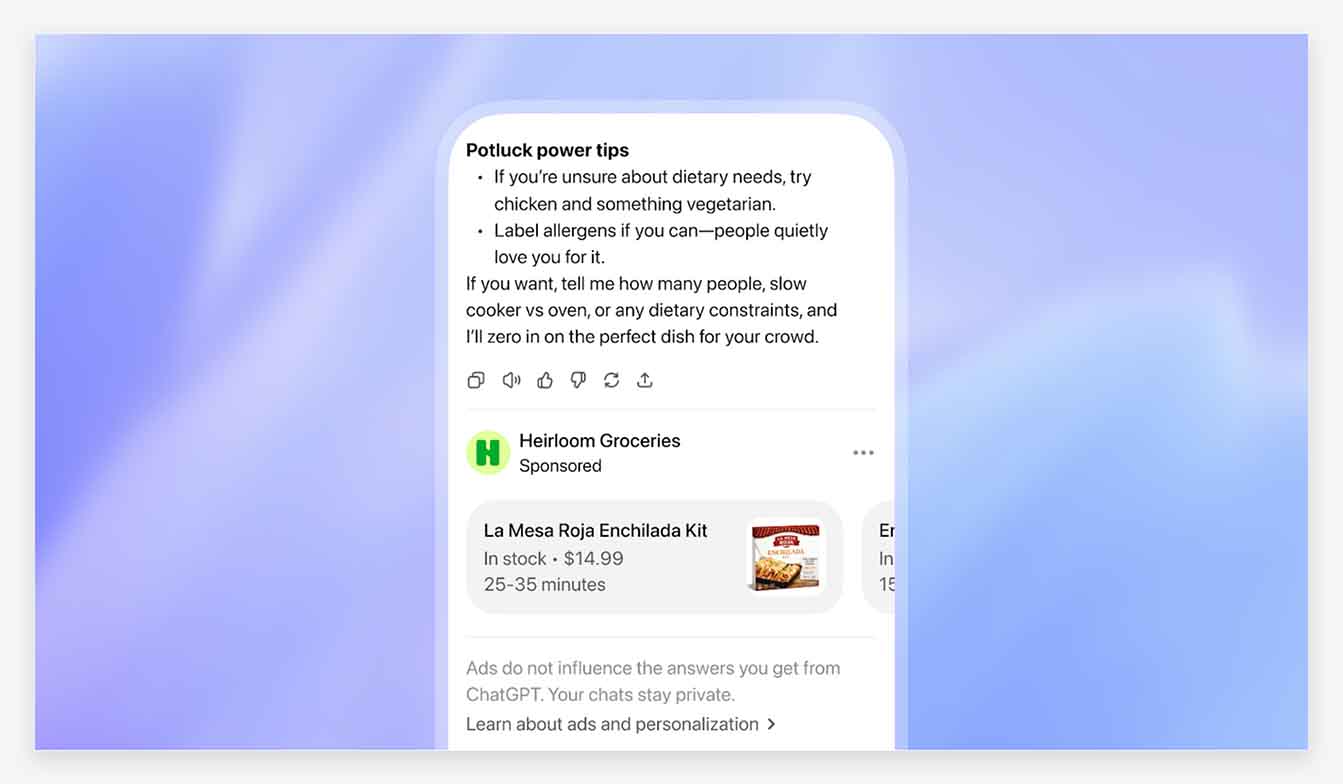
As per the official OpenAI ChatGPT release notes, the ad serving test began February 9, 2026, and for now is limited to logged-in adult users in the US on the Free tier and the most affordable $8/month Go tier. Plus, Pro, Business, Enterprise, and Education accounts are excluded from ads during this test. Ads appear as a separate unit below the end of a response (not embedded into the assistant’s answer text).
Here is All We Know:
The timeline. OpenAI previewed the move on January 16, 2026, publishing its advertising “principles” and directly stating that they are planning to test ads “in the coming weeks” for logged-in US adults on both the “Free” and “Go” plans. The tests have officially begun on February 9, 2026.
Where ads show up. OpenAI claims that ads can appear below a response and, during this test, won’t appear when you’re logged out, in Temporary Chats, after image generation, or in the ChatGPT Atlas web browser.
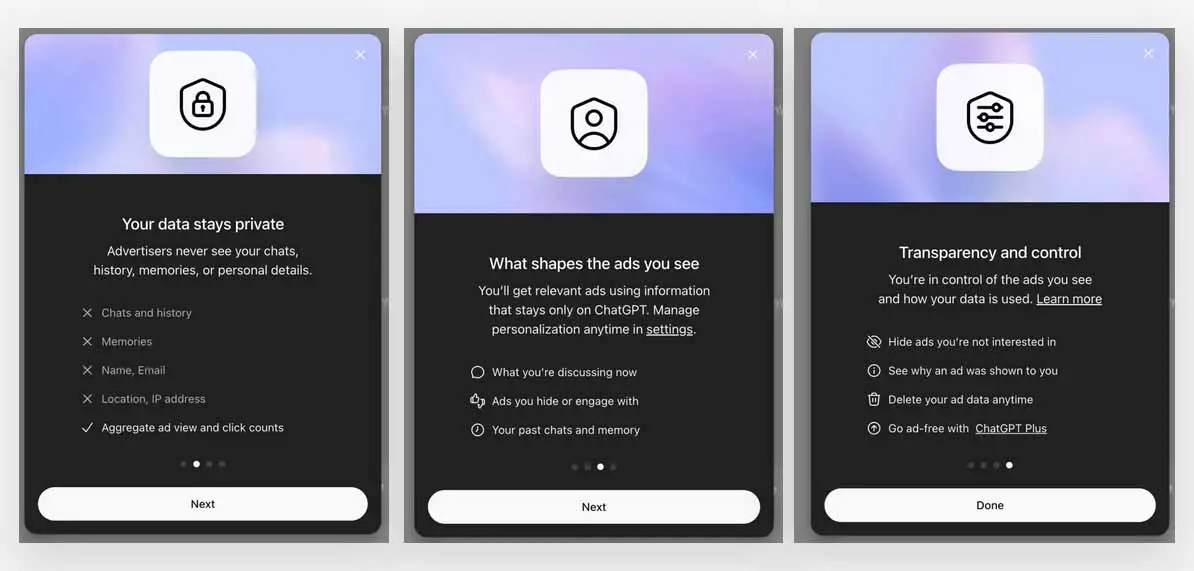
How ad selection works. The advertiser submissions are said to be matched to the conversation topic plus past chats and prior interactions with ads. The Help Center notes that basic context, such as general location or language, is used. Additionally, if the “Personalized Ads” setting is enabled, past chats and memory will also affect the ad selection starting in February 2026. This means that if you have the memory feature turned on and have not opted out of Personalized Ads, their content will automatically adjust to what ChatGPT has learned about you during all your past conversations.
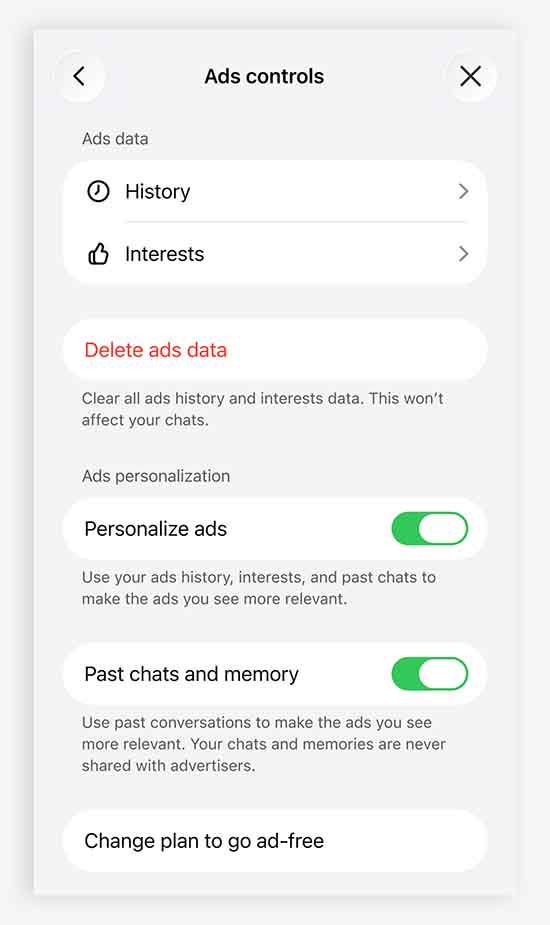
Controls and opt-outs. Users can hide/report ads as in almost any other digital ad system, open an “About this ad” context menu, delete their ad data, as well as toggle the aforementioned ad personalization (whether past chats/memory are taken into account when serving ads to your account). What’s quite interesting is that the free plan users can actually switch to an Ads‑Free mode at any time, although doing so they will be faced with lower chat message limits and reduced tool access.
Safeguards OpenAI claims. The official statement from OpenAI is that ads don’t influence chat answers, run on systems separate from the chat model, and advertisers cannot shape, rank, or alter the model’s responses. Advertisers receive only aggregate reporting (views/clicks) when monitoring their ad campaigns. Users below the age of 18 won’t see any ads at all, and ads are excluded near topics marked as sensitive, such as health, mental health, politics, and so on.
How Does It All Compare To ChatGPT’s Rivals? (Perplexity, Gemini, etc.)
Perplexity.ai actually began experimenting with ads back in 2024 using sponsored follow-up questions and adjacent placements, emphasizing advertisers don’t write the answer text.
Google’s Gemini already inserts ads into AI-generated search experiences (AI Overviews and AI Mode), clearly labeled as “Sponsored”. Google executives publicly deny current plans for ads inside the Gemini app after reporting suggested a 2026 rollout.
Microsoft’s Bing has also been exploring ads in AI chat as part of Bing search since 2023, having promoted interactive Copilot ad formats like “Showroom ads” designed for conversational commerce via modernized in-search product displays.
What Does It Mean For You?
As always, trust is the most critical factor. Although the ads in their current format are clearly separated from the model’s responses, they inevitably influence how the user interprets the reply, once the user sees them.
Privacy is another issue. Even if advertisers don’t see chats, OpenAI in theory can still use chat-derived signals (and, if enabled, memory/past chats) to select ads, which may feel intrusive for users who treat chats as personal and private.
What’s also important is how well OpenAI will implement ad scam-prevention mechanisms, as almost all digital ad market areas carry the risk of falling victim to malicious advertisers. Knowing many examples of ads on YouTube that often slip through their filter, it’s understandable to be a little bit uneasy about the things to come in that regard, especially with the level of trust some users give to the ChatGPT’s outputs.
Time will tell if the ads will stay bound to the Free and Go plans, or if they will also be introduced to the other paid plans as time goes by. For now, all we can do is watch how the events unfold.
You might also like: LLM Tokens-per-Second (t/s) Generation Speed Simulator